
| Name | Value |
|---|---|
| Title | Truth and Reconciliation - 2025 - Bentwood Box |
| Year | 2025 |
| Stamp Count | 3 |
| Country | Canada |
In partnership with the Survivors Circle of the National Centre for Truth and Reconciliation, this series of stamps seeks to raise awareness about residential schools and the legacy of trauma and abuse that continues to have an impact on Indigenous Peoples today.
The Survivors Circle selected the Bentwood Box (Medicine Box) to be featured on this year’s stamps in this ongoing series.
A lasting tribute to all residential school Survivors, the Bentwood Box is a symbol of healing, reconciliation and hope.
Canada Post is committed to listening to Indigenous voices and to using these stamps as a vehicle for Survivors to share the truth of their experiences so that we can support the process of reconciliation and, ultimately, healing, as we move forward.
Canada Post thanks the Survivors Circle of the National Centre for Truth and Reconciliation for their guidance throughout this process.
Commissioned by the Truth and Reconciliation Commission (TRC) in 2009, the Bentwood Box (Medicine Box) travelled with the TRC to its eight national events. People placed sacred items into the box to symbolize their spiritual journey toward healing and as gestures of truth and reconciliation. These included thousands of items from across the country, such as photographs, reports, books, drums, knitted baby blankets and beaded regalia.
The box was crafted by Coast Salish artist Luke Marston in the traditional style from a single piece of sacred old-growth red cedar. Its carved panels feature artistic styles and imagery that represent the distinct cultures of First Nations, Métis and Inuit who attended residential schools.
During the TRC’s work, the box gathered the voices and experiences of those impacted by Canada’s residential school system, ensuring their stories were honoured and remembered. After being housed temporarily at the Canadian Museum for Human Rights in Winnipeg, Manitoba, it now resides at the National Centre for Truth and Reconciliation in the same city. The Bentwood Box is a powerful symbol that reminds Canadians of the need to confront the past, work toward healing and hold hope for future generations.
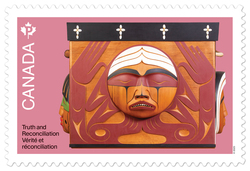
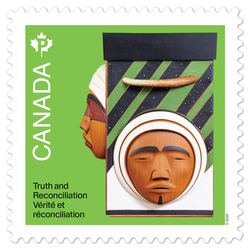
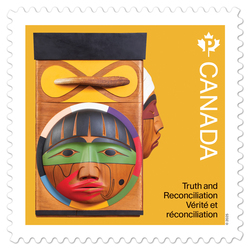
Each of the three stamps features a different side of the Bentwood Box that represents the distinct cultures of First Nations, Inuit and Métis children who attended residential schools.
Through carefully considered proportions, the two different stamp sizes work together to create a balanced and inclusive expression – one that elevates the distinct voices of First Nations, Inuit and Métis children who endured the residential school system.
On the rectangular stamp depicting the front panel of the box, crosses represent the churches that ran residential schools (with the federal government), while raised hands symbolize the helplessness felt by parents when their children were taken away from them and sent to residential schools.
The square stamp with a green background depicts the side panel of the box that relates Inuit experiences at residential schools. The northern lights and the stars beyond represent Inuit ancestors and teachings. Students were separated from this knowledge while at residential schools.
The square stamp with a yellow background shows the side panel of the box that depicts student experiences from the Prairies and Eastern Canada. The infinity symbol, found on the Métis flag, acknowledges the Métis children who were taken to residential schools.
The back panel of the box, featuring Thunderbird, does not appear on the stamps. It is found on the inside of the booklet and on the back of the OFDC. The carving of Thunderbird on the back panel of the box proclaims the strong voices of Indigenous Peoples.